

-
1 arc fault
- "дуговая" неисправность
"дуговая" неисправность
Неисправность, приводящая к возникновению дуги.
[Интент]Параллельные тексты EN-RU
An arc fault occurs when there is a reduction in the dielectric strength of the insulating means (air, in LV switchboards) interposed between two or more conducting elements at different potential.
The arc is generated at the moment when, due to the high ionization of the air, there is a breakdown of the dielectric of the medium and the consequent flow of the current through it.
In an arc fault the highest stresses are of thermal type and proportional to RaI2 owing to the high value taken by the arc resistance Ra; this because the fault current flows in a medium which is always insulating, even if extremely ionized.
Such stresses manifest themselves essentially in the form of:
• high thermal gradients caused by the quick and intense rise in the air temperature;
• high pressure gradients in the form of pressure wave;
• high ionization of the air with consequent reduction of its insulating strength.
Generally speaking, in a LV assembly designed and tested according to the Standard IEC 60439-1 an arc fault is not very likely to occur; however, should it occur, the consequences would be extremely harmful to both the equipment as well as the personnel (see Chapters 2.2 and 2.3).
The causes of an arc fault can be both technical as well as non technical; among the latter the most frequent are the following:
• personnel errors, above all during maintenance operations;
• installation operations not sufficiently accurate;
• inadequate maintenance, above all in the case of severe environmental conditions.
Among the technical causes of an arc fault in a LV assembly the following ones are to be remembered:
• breakdown of the insulation essentially in the proximity of the supports of the busbars and of the plug-in contacts of the withdrawable units (75% of cases);
• overvoltages generating disruptive discharges between the points at minimum clearances (15% of cases);
• constructional defects of the apparatus (10% of cases).
[ABB]К «дуговой» неисправности, относится неисправность, обусловленная уменьшением электрической прочности изолирующей среды (воздуха в НКУ) между двумя или более токоведущими частями, находящимися под разными электрическими потенциалами.
Дуга образуется в тот момент, когда вследствие высокой ионизации воздуха происходит пробой изолирующей среды, вследствие чего через нее начинает протекать электрический ток.
Проявлением дуговой неисправности, является тепловое воздействие, пропорциональное RaI2 и достигающее большого значения вследствие большого сопротивления дуги Ra.
Дело в том, что ток дуги протекает через среду, которая всегда является изолирующей, пусть даже и чрезвычайно ионизированной.
Указанные воздействия очевидны сами по себе особенно в форме:
• теплового градиента температуры, вызванного быстрым и интенсивным подъемом температуры воздуха;
• высоким градиентом давления в форме волны давления;
• высокой ионизацией воздуха с последующим уменьшением электрической прочности.
Вообще говоря, в НКУ, разработанных и испытанных в соответствии с требованиями стандарта МЭК 60439-1 «дуговая» неисправность маловероятна. Однако, если дуга все таки возникнет, ее последствия буду чрезвычайно тяжелыми как для оборудования, так и для персонала (см. п. 2.2 и 2.3).
Причина дуговой неисправности может носить как технический, так и нетехнический характер. Среди последних наиболее часто возникают следующие:
• ошибки персонала, совершаемые главным образом во время технического обслуживания;
• недостаточно аккуратное выполнение монтажа;
• ненадлежащее техническое обслуживание, главным образом при эксплуатации НКУ в тяжелых условиях окружающей среды.
Среди технических причин дуговой неисправности в НКУ необходимо помнить о следующих:
• пробой изоляции, особенно вблизи опор шин и втычных контактов выдвижных частей НКУ (75 % случаев);
• перенапряжения, вызываемые разрушительными электрическими разрядами между точками с минимальными зазорами (15 % случаев);
• конструктивные дефекты аппаратуры (10 % случаев).
[Перевод Интент]Тематики
- НКУ (шкафы, пульты,...)
EN
Англо-русский словарь нормативно-технической терминологии > arc fault
-
2 DOL
- эффект операционного рычага
- пускатель прямого действия
- прямой пуск вращающегося электродвигателя
- Министерство труда (США)
- концентрация растворённого кислорода
концентрация растворённого кислорода
—
[А.С.Гольдберг. Англо-русский энергетический словарь. 2006 г.]Тематики
EN
Министерство труда (США)
—
[А.С.Гольдберг. Англо-русский энергетический словарь. 2006 г.]Тематики
EN
прямой пуск вращающегося электродвигателя
Пуск вращающегося электродвигателя путем непосредственного подключения его к питающей сети.
[ ГОСТ 27471-87]EN
direct-on-line starting
across-the-line starting (US)
the process of starting a motor by connecting it directly to the supply at rated voltage
[IEV number 411-52-15]FR
démarrage direct
mode de démarrage d'un moteur, consistant à lui appliquer directement sa pleine tension assignée
[IEV number 411-52-15]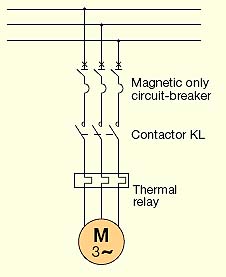
Рис. ABB
Схема прямого пуска электродвигателяMagnetic only circuit-breaker - Автоматический выключатель с электромагнитным расцепителем
Contactor KL - Контактор KL
Thermal relay - Тепловое реле
Параллельные тексты EN-RU
Direct-on-line starting
Direct-on-line starting, which is often abbreviated as DOL, is perhaps the most traditional system and consists in connecting the motor directly to the supply network, thus carrying out starting at full voltage.Direct-on-line starting represents the simplest and the most economical system to start a squirrel-cage asynchronous motor and it is the most used.
As represented in Figure 5, it provides the direct connection to the supply network and therefore starting is carried out at full voltage and with constant frequency, developing a high starting torque with very reduced acceleration times.
The typical applications are relevant to small power motors also with full load starting.
These advantages are linked to some problems such as, for example, the high inrush current, which - in the first instants - can reach values of about 10 to 12 times the rated current, then can decrease to about 6 to 8 times the rated current and can persist to reach the maximum torque speed.The effects of such currents can be identified with the high electro-dynamical stresses on the motor connection cables and could affect also the windings of the motor itself; besides, the high inrush torques can cause violent accelerations which stress the transmission components (belts and joints) generating distribution problems with a reduction in the mechanical life of these elements.
Finally, also the possible electrical problems due to voltage drops on the supply line of the motor or of the connected equipment must be taken into consideration.
[ABB]Прямой пуск
Прямой пуск, который по-английски часто сокращенно обозначают как DOL, является, пожалуй наиболее распространенным способом пуска. Он заключается в непосредственном (т. е. прямом) подключении двигателя к питающей сети. Это означает, что пуск двигателя осуществляется при полном напряжении.Схема прямого пуска является наиболее простым, экономичным и чаще всего применяемым решением для электродвигателей с короткозамкнутым ротором.
Схема прямого подключения к сети представлена на рисунке 5. Пуск осуществляется при полном напряжении и постоянной частоте сети. Электродвигатель развивает высокий пусковой момент при коротком времени разгона.
Типичные области применения – маломощные электродвигатели, в том числе с пуском при полной нагрузке.
Однако, наряду с преимуществами имеются и определенные недостатки, например, бросок пускового тока, достигающий в первоначальный момент 10…12-кратного значения от номинального тока электродвигателя. Затем ток двигателя уменьшается примерно до 6…8-кратного значения номинального тока и будет держаться на этом уровне до тех пор, пока скорость двигателя не достигнет максимального значения.
Такое изменение тока оказывает значительное электродинамическое воздействие на кабель, подключенный к двигателю. Кроме того пусковой ток воздействует на обмотки двигателя. Высокий начальный пусковой момент может привести к значительному ускорению и следовательно к значительной нагрузке элементов привода (ремней, крепления узлов), что вызывает сокращение их срока службы.
И, наконец, следует принять во внимание возможное возникновение проблем, связанных с падением напряжения в линии питания двигателя и подключенного к этой линии оборудования.
[Перевод Интент]
Тематики
Синонимы
EN
- across-the-line starting (US)
- direct line starting
- direct operation of a motor
- direct starting
- direct-on-line starting
- DOL
- full voltage starter application
DE
FR
пускатель прямого действия
Пускатель, одноступенчато подающий сетевое напряжение на выводы двигателя.
(МЭС 441-14-40)
[ ГОСТ Р 50030.4.1-2002 (МЭК 60947-4-1-2000)]
Пускатели переменного тока для прямого непосредственного пуска (с полным напряжением)
Пускатели, предназначенные для пуска двигателя, разгона его до номинальной скорости, защиты двигателя и подключенных к нему цепей от рабочих перегрузок и отключения питания двигателя.
[ ГОСТ Р 50030.4.1-2002 (МЭК 60947-4-1-2000)]EN
direct-on-line starter
a starter which connects the line voltage across the motor terminals in one step
[IEV number 441-14-40]FR
démarreur direct
démarreur qui applique la tension d'alimentation sur les bornes du moteur en une seule manoeuvre
[IEV number 441-14-40]Параллельные тексты EN-RU
Direct-on-line starters
Starters which connect the line voltage across the motor terminals in one step, intended to start and accelerate a motor to normal speed.
They shall ensure switching and protection functions as prescribed in the general definition.
[ABB]Пускатели прямого действия
Пускатели, одноступенчато подающие сетевое напряжение на зажимы двигателя и предназначенные для его пуска и разгона до номинальной скорости.
Кроме того, они должны обеспечивать коммутацию и защиту в соответствии с общим определением.
[Перевод Интент]Тематики
EN
DE
FR
эффект операционного рычага
эффект производственного рычага
Эффект операционного рычага - выражение того факта, что любое изменение выручки от реализации порождает изменение прибыли. Сила воздействия операционного рычага вычисляется как частное от деления выручки от реализации после возмещения переменных затрат на прибыль.
[ http://www.lexikon.ru/dict/fin/a.html]Тематики
Синонимы
EN
Англо-русский словарь нормативно-технической терминологии > DOL
-
3 direct starting
прямой пуск
—
[Я.Н.Лугинский, М.С.Фези-Жилинская, Ю.С.Кабиров. Англо-русский словарь по электротехнике и электроэнергетике, Москва, 1999 г.]Тематики
- электротехника, основные понятия
EN
прямой пуск вращающегося электродвигателя
Пуск вращающегося электродвигателя путем непосредственного подключения его к питающей сети.
[ ГОСТ 27471-87]EN
direct-on-line starting
across-the-line starting (US)
the process of starting a motor by connecting it directly to the supply at rated voltage
[IEV number 411-52-15]FR
démarrage direct
mode de démarrage d'un moteur, consistant à lui appliquer directement sa pleine tension assignée
[IEV number 411-52-15]
Рис. ABB
Схема прямого пуска электродвигателяMagnetic only circuit-breaker - Автоматический выключатель с электромагнитным расцепителем
Contactor KL - Контактор KL
Thermal relay - Тепловое реле
Параллельные тексты EN-RU
Direct-on-line starting
Direct-on-line starting, which is often abbreviated as DOL, is perhaps the most traditional system and consists in connecting the motor directly to the supply network, thus carrying out starting at full voltage.Direct-on-line starting represents the simplest and the most economical system to start a squirrel-cage asynchronous motor and it is the most used.
As represented in Figure 5, it provides the direct connection to the supply network and therefore starting is carried out at full voltage and with constant frequency, developing a high starting torque with very reduced acceleration times.
The typical applications are relevant to small power motors also with full load starting.
These advantages are linked to some problems such as, for example, the high inrush current, which - in the first instants - can reach values of about 10 to 12 times the rated current, then can decrease to about 6 to 8 times the rated current and can persist to reach the maximum torque speed.The effects of such currents can be identified with the high electro-dynamical stresses on the motor connection cables and could affect also the windings of the motor itself; besides, the high inrush torques can cause violent accelerations which stress the transmission components (belts and joints) generating distribution problems with a reduction in the mechanical life of these elements.
Finally, also the possible electrical problems due to voltage drops on the supply line of the motor or of the connected equipment must be taken into consideration.
[ABB]Прямой пуск
Прямой пуск, который по-английски часто сокращенно обозначают как DOL, является, пожалуй наиболее распространенным способом пуска. Он заключается в непосредственном (т. е. прямом) подключении двигателя к питающей сети. Это означает, что пуск двигателя осуществляется при полном напряжении.Схема прямого пуска является наиболее простым, экономичным и чаще всего применяемым решением для электродвигателей с короткозамкнутым ротором.
Схема прямого подключения к сети представлена на рисунке 5. Пуск осуществляется при полном напряжении и постоянной частоте сети. Электродвигатель развивает высокий пусковой момент при коротком времени разгона.
Типичные области применения – маломощные электродвигатели, в том числе с пуском при полной нагрузке.
Однако, наряду с преимуществами имеются и определенные недостатки, например, бросок пускового тока, достигающий в первоначальный момент 10…12-кратного значения от номинального тока электродвигателя. Затем ток двигателя уменьшается примерно до 6…8-кратного значения номинального тока и будет держаться на этом уровне до тех пор, пока скорость двигателя не достигнет максимального значения.
Такое изменение тока оказывает значительное электродинамическое воздействие на кабель, подключенный к двигателю. Кроме того пусковой ток воздействует на обмотки двигателя. Высокий начальный пусковой момент может привести к значительному ускорению и следовательно к значительной нагрузке элементов привода (ремней, крепления узлов), что вызывает сокращение их срока службы.
И, наконец, следует принять во внимание возможное возникновение проблем, связанных с падением напряжения в линии питания двигателя и подключенного к этой линии оборудования.
[Перевод Интент]
Тематики
Синонимы
EN
- across-the-line starting (US)
- direct line starting
- direct operation of a motor
- direct starting
- direct-on-line starting
- DOL
- full voltage starter application
DE
FR
Англо-русский словарь нормативно-технической терминологии > direct starting
-
4 across-the-line starting (US)
прямой пуск вращающегося электродвигателя
Пуск вращающегося электродвигателя путем непосредственного подключения его к питающей сети.
[ ГОСТ 27471-87]EN
direct-on-line starting
across-the-line starting (US)
the process of starting a motor by connecting it directly to the supply at rated voltage
[IEV number 411-52-15]FR
démarrage direct
mode de démarrage d'un moteur, consistant à lui appliquer directement sa pleine tension assignée
[IEV number 411-52-15]
Рис. ABB
Схема прямого пуска электродвигателяMagnetic only circuit-breaker - Автоматический выключатель с электромагнитным расцепителем
Contactor KL - Контактор KL
Thermal relay - Тепловое реле
Параллельные тексты EN-RU
Direct-on-line starting
Direct-on-line starting, which is often abbreviated as DOL, is perhaps the most traditional system and consists in connecting the motor directly to the supply network, thus carrying out starting at full voltage.Direct-on-line starting represents the simplest and the most economical system to start a squirrel-cage asynchronous motor and it is the most used.
As represented in Figure 5, it provides the direct connection to the supply network and therefore starting is carried out at full voltage and with constant frequency, developing a high starting torque with very reduced acceleration times.
The typical applications are relevant to small power motors also with full load starting.
These advantages are linked to some problems such as, for example, the high inrush current, which - in the first instants - can reach values of about 10 to 12 times the rated current, then can decrease to about 6 to 8 times the rated current and can persist to reach the maximum torque speed.The effects of such currents can be identified with the high electro-dynamical stresses on the motor connection cables and could affect also the windings of the motor itself; besides, the high inrush torques can cause violent accelerations which stress the transmission components (belts and joints) generating distribution problems with a reduction in the mechanical life of these elements.
Finally, also the possible electrical problems due to voltage drops on the supply line of the motor or of the connected equipment must be taken into consideration.
[ABB]Прямой пуск
Прямой пуск, который по-английски часто сокращенно обозначают как DOL, является, пожалуй наиболее распространенным способом пуска. Он заключается в непосредственном (т. е. прямом) подключении двигателя к питающей сети. Это означает, что пуск двигателя осуществляется при полном напряжении.Схема прямого пуска является наиболее простым, экономичным и чаще всего применяемым решением для электродвигателей с короткозамкнутым ротором.
Схема прямого подключения к сети представлена на рисунке 5. Пуск осуществляется при полном напряжении и постоянной частоте сети. Электродвигатель развивает высокий пусковой момент при коротком времени разгона.
Типичные области применения – маломощные электродвигатели, в том числе с пуском при полной нагрузке.
Однако, наряду с преимуществами имеются и определенные недостатки, например, бросок пускового тока, достигающий в первоначальный момент 10…12-кратного значения от номинального тока электродвигателя. Затем ток двигателя уменьшается примерно до 6…8-кратного значения номинального тока и будет держаться на этом уровне до тех пор, пока скорость двигателя не достигнет максимального значения.
Такое изменение тока оказывает значительное электродинамическое воздействие на кабель, подключенный к двигателю. Кроме того пусковой ток воздействует на обмотки двигателя. Высокий начальный пусковой момент может привести к значительному ускорению и следовательно к значительной нагрузке элементов привода (ремней, крепления узлов), что вызывает сокращение их срока службы.
И, наконец, следует принять во внимание возможное возникновение проблем, связанных с падением напряжения в линии питания двигателя и подключенного к этой линии оборудования.
[Перевод Интент]
Тематики
Синонимы
EN
- across-the-line starting (US)
- direct line starting
- direct operation of a motor
- direct starting
- direct-on-line starting
- DOL
- full voltage starter application
DE
FR
Англо-русский словарь нормативно-технической терминологии > across-the-line starting (US)
-
5 direct line starting
прямой пуск вращающегося электродвигателя
Пуск вращающегося электродвигателя путем непосредственного подключения его к питающей сети.
[ ГОСТ 27471-87]EN
direct-on-line starting
across-the-line starting (US)
the process of starting a motor by connecting it directly to the supply at rated voltage
[IEV number 411-52-15]FR
démarrage direct
mode de démarrage d'un moteur, consistant à lui appliquer directement sa pleine tension assignée
[IEV number 411-52-15]
Рис. ABB
Схема прямого пуска электродвигателяMagnetic only circuit-breaker - Автоматический выключатель с электромагнитным расцепителем
Contactor KL - Контактор KL
Thermal relay - Тепловое реле
Параллельные тексты EN-RU
Direct-on-line starting
Direct-on-line starting, which is often abbreviated as DOL, is perhaps the most traditional system and consists in connecting the motor directly to the supply network, thus carrying out starting at full voltage.Direct-on-line starting represents the simplest and the most economical system to start a squirrel-cage asynchronous motor and it is the most used.
As represented in Figure 5, it provides the direct connection to the supply network and therefore starting is carried out at full voltage and with constant frequency, developing a high starting torque with very reduced acceleration times.
The typical applications are relevant to small power motors also with full load starting.
These advantages are linked to some problems such as, for example, the high inrush current, which - in the first instants - can reach values of about 10 to 12 times the rated current, then can decrease to about 6 to 8 times the rated current and can persist to reach the maximum torque speed.The effects of such currents can be identified with the high electro-dynamical stresses on the motor connection cables and could affect also the windings of the motor itself; besides, the high inrush torques can cause violent accelerations which stress the transmission components (belts and joints) generating distribution problems with a reduction in the mechanical life of these elements.
Finally, also the possible electrical problems due to voltage drops on the supply line of the motor or of the connected equipment must be taken into consideration.
[ABB]Прямой пуск
Прямой пуск, который по-английски часто сокращенно обозначают как DOL, является, пожалуй наиболее распространенным способом пуска. Он заключается в непосредственном (т. е. прямом) подключении двигателя к питающей сети. Это означает, что пуск двигателя осуществляется при полном напряжении.Схема прямого пуска является наиболее простым, экономичным и чаще всего применяемым решением для электродвигателей с короткозамкнутым ротором.
Схема прямого подключения к сети представлена на рисунке 5. Пуск осуществляется при полном напряжении и постоянной частоте сети. Электродвигатель развивает высокий пусковой момент при коротком времени разгона.
Типичные области применения – маломощные электродвигатели, в том числе с пуском при полной нагрузке.
Однако, наряду с преимуществами имеются и определенные недостатки, например, бросок пускового тока, достигающий в первоначальный момент 10…12-кратного значения от номинального тока электродвигателя. Затем ток двигателя уменьшается примерно до 6…8-кратного значения номинального тока и будет держаться на этом уровне до тех пор, пока скорость двигателя не достигнет максимального значения.
Такое изменение тока оказывает значительное электродинамическое воздействие на кабель, подключенный к двигателю. Кроме того пусковой ток воздействует на обмотки двигателя. Высокий начальный пусковой момент может привести к значительному ускорению и следовательно к значительной нагрузке элементов привода (ремней, крепления узлов), что вызывает сокращение их срока службы.
И, наконец, следует принять во внимание возможное возникновение проблем, связанных с падением напряжения в линии питания двигателя и подключенного к этой линии оборудования.
[Перевод Интент]
Тематики
Синонимы
EN
- across-the-line starting (US)
- direct line starting
- direct operation of a motor
- direct starting
- direct-on-line starting
- DOL
- full voltage starter application
DE
FR
Англо-русский словарь нормативно-технической терминологии > direct line starting
-
6 direct operation of a motor
прямой пуск вращающегося электродвигателя
Пуск вращающегося электродвигателя путем непосредственного подключения его к питающей сети.
[ ГОСТ 27471-87]EN
direct-on-line starting
across-the-line starting (US)
the process of starting a motor by connecting it directly to the supply at rated voltage
[IEV number 411-52-15]FR
démarrage direct
mode de démarrage d'un moteur, consistant à lui appliquer directement sa pleine tension assignée
[IEV number 411-52-15]
Рис. ABB
Схема прямого пуска электродвигателяMagnetic only circuit-breaker - Автоматический выключатель с электромагнитным расцепителем
Contactor KL - Контактор KL
Thermal relay - Тепловое реле
Параллельные тексты EN-RU
Direct-on-line starting
Direct-on-line starting, which is often abbreviated as DOL, is perhaps the most traditional system and consists in connecting the motor directly to the supply network, thus carrying out starting at full voltage.Direct-on-line starting represents the simplest and the most economical system to start a squirrel-cage asynchronous motor and it is the most used.
As represented in Figure 5, it provides the direct connection to the supply network and therefore starting is carried out at full voltage and with constant frequency, developing a high starting torque with very reduced acceleration times.
The typical applications are relevant to small power motors also with full load starting.
These advantages are linked to some problems such as, for example, the high inrush current, which - in the first instants - can reach values of about 10 to 12 times the rated current, then can decrease to about 6 to 8 times the rated current and can persist to reach the maximum torque speed.The effects of such currents can be identified with the high electro-dynamical stresses on the motor connection cables and could affect also the windings of the motor itself; besides, the high inrush torques can cause violent accelerations which stress the transmission components (belts and joints) generating distribution problems with a reduction in the mechanical life of these elements.
Finally, also the possible electrical problems due to voltage drops on the supply line of the motor or of the connected equipment must be taken into consideration.
[ABB]Прямой пуск
Прямой пуск, который по-английски часто сокращенно обозначают как DOL, является, пожалуй наиболее распространенным способом пуска. Он заключается в непосредственном (т. е. прямом) подключении двигателя к питающей сети. Это означает, что пуск двигателя осуществляется при полном напряжении.Схема прямого пуска является наиболее простым, экономичным и чаще всего применяемым решением для электродвигателей с короткозамкнутым ротором.
Схема прямого подключения к сети представлена на рисунке 5. Пуск осуществляется при полном напряжении и постоянной частоте сети. Электродвигатель развивает высокий пусковой момент при коротком времени разгона.
Типичные области применения – маломощные электродвигатели, в том числе с пуском при полной нагрузке.
Однако, наряду с преимуществами имеются и определенные недостатки, например, бросок пускового тока, достигающий в первоначальный момент 10…12-кратного значения от номинального тока электродвигателя. Затем ток двигателя уменьшается примерно до 6…8-кратного значения номинального тока и будет держаться на этом уровне до тех пор, пока скорость двигателя не достигнет максимального значения.
Такое изменение тока оказывает значительное электродинамическое воздействие на кабель, подключенный к двигателю. Кроме того пусковой ток воздействует на обмотки двигателя. Высокий начальный пусковой момент может привести к значительному ускорению и следовательно к значительной нагрузке элементов привода (ремней, крепления узлов), что вызывает сокращение их срока службы.
И, наконец, следует принять во внимание возможное возникновение проблем, связанных с падением напряжения в линии питания двигателя и подключенного к этой линии оборудования.
[Перевод Интент]
Тематики
Синонимы
EN
- across-the-line starting (US)
- direct line starting
- direct operation of a motor
- direct starting
- direct-on-line starting
- DOL
- full voltage starter application
DE
FR
Англо-русский словарь нормативно-технической терминологии > direct operation of a motor
-
7 direct-on-line starting
прямой пуск вращающегося электродвигателя
Пуск вращающегося электродвигателя путем непосредственного подключения его к питающей сети.
[ ГОСТ 27471-87]EN
direct-on-line starting
across-the-line starting (US)
the process of starting a motor by connecting it directly to the supply at rated voltage
[IEV number 411-52-15]FR
démarrage direct
mode de démarrage d'un moteur, consistant à lui appliquer directement sa pleine tension assignée
[IEV number 411-52-15]
Рис. ABB
Схема прямого пуска электродвигателяMagnetic only circuit-breaker - Автоматический выключатель с электромагнитным расцепителем
Contactor KL - Контактор KL
Thermal relay - Тепловое реле
Параллельные тексты EN-RU
Direct-on-line starting
Direct-on-line starting, which is often abbreviated as DOL, is perhaps the most traditional system and consists in connecting the motor directly to the supply network, thus carrying out starting at full voltage.Direct-on-line starting represents the simplest and the most economical system to start a squirrel-cage asynchronous motor and it is the most used.
As represented in Figure 5, it provides the direct connection to the supply network and therefore starting is carried out at full voltage and with constant frequency, developing a high starting torque with very reduced acceleration times.
The typical applications are relevant to small power motors also with full load starting.
These advantages are linked to some problems such as, for example, the high inrush current, which - in the first instants - can reach values of about 10 to 12 times the rated current, then can decrease to about 6 to 8 times the rated current and can persist to reach the maximum torque speed.The effects of such currents can be identified with the high electro-dynamical stresses on the motor connection cables and could affect also the windings of the motor itself; besides, the high inrush torques can cause violent accelerations which stress the transmission components (belts and joints) generating distribution problems with a reduction in the mechanical life of these elements.
Finally, also the possible electrical problems due to voltage drops on the supply line of the motor or of the connected equipment must be taken into consideration.
[ABB]Прямой пуск
Прямой пуск, который по-английски часто сокращенно обозначают как DOL, является, пожалуй наиболее распространенным способом пуска. Он заключается в непосредственном (т. е. прямом) подключении двигателя к питающей сети. Это означает, что пуск двигателя осуществляется при полном напряжении.Схема прямого пуска является наиболее простым, экономичным и чаще всего применяемым решением для электродвигателей с короткозамкнутым ротором.
Схема прямого подключения к сети представлена на рисунке 5. Пуск осуществляется при полном напряжении и постоянной частоте сети. Электродвигатель развивает высокий пусковой момент при коротком времени разгона.
Типичные области применения – маломощные электродвигатели, в том числе с пуском при полной нагрузке.
Однако, наряду с преимуществами имеются и определенные недостатки, например, бросок пускового тока, достигающий в первоначальный момент 10…12-кратного значения от номинального тока электродвигателя. Затем ток двигателя уменьшается примерно до 6…8-кратного значения номинального тока и будет держаться на этом уровне до тех пор, пока скорость двигателя не достигнет максимального значения.
Такое изменение тока оказывает значительное электродинамическое воздействие на кабель, подключенный к двигателю. Кроме того пусковой ток воздействует на обмотки двигателя. Высокий начальный пусковой момент может привести к значительному ускорению и следовательно к значительной нагрузке элементов привода (ремней, крепления узлов), что вызывает сокращение их срока службы.
И, наконец, следует принять во внимание возможное возникновение проблем, связанных с падением напряжения в линии питания двигателя и подключенного к этой линии оборудования.
[Перевод Интент]
Тематики
Синонимы
EN
- across-the-line starting (US)
- direct line starting
- direct operation of a motor
- direct starting
- direct-on-line starting
- DOL
- full voltage starter application
DE
FR
Англо-русский словарь нормативно-технической терминологии > direct-on-line starting
-
8 full voltage starter application
прямой пуск вращающегося электродвигателя
Пуск вращающегося электродвигателя путем непосредственного подключения его к питающей сети.
[ ГОСТ 27471-87]EN
direct-on-line starting
across-the-line starting (US)
the process of starting a motor by connecting it directly to the supply at rated voltage
[IEV number 411-52-15]FR
démarrage direct
mode de démarrage d'un moteur, consistant à lui appliquer directement sa pleine tension assignée
[IEV number 411-52-15]
Рис. ABB
Схема прямого пуска электродвигателяMagnetic only circuit-breaker - Автоматический выключатель с электромагнитным расцепителем
Contactor KL - Контактор KL
Thermal relay - Тепловое реле
Параллельные тексты EN-RU
Direct-on-line starting
Direct-on-line starting, which is often abbreviated as DOL, is perhaps the most traditional system and consists in connecting the motor directly to the supply network, thus carrying out starting at full voltage.Direct-on-line starting represents the simplest and the most economical system to start a squirrel-cage asynchronous motor and it is the most used.
As represented in Figure 5, it provides the direct connection to the supply network and therefore starting is carried out at full voltage and with constant frequency, developing a high starting torque with very reduced acceleration times.
The typical applications are relevant to small power motors also with full load starting.
These advantages are linked to some problems such as, for example, the high inrush current, which - in the first instants - can reach values of about 10 to 12 times the rated current, then can decrease to about 6 to 8 times the rated current and can persist to reach the maximum torque speed.The effects of such currents can be identified with the high electro-dynamical stresses on the motor connection cables and could affect also the windings of the motor itself; besides, the high inrush torques can cause violent accelerations which stress the transmission components (belts and joints) generating distribution problems with a reduction in the mechanical life of these elements.
Finally, also the possible electrical problems due to voltage drops on the supply line of the motor or of the connected equipment must be taken into consideration.
[ABB]Прямой пуск
Прямой пуск, который по-английски часто сокращенно обозначают как DOL, является, пожалуй наиболее распространенным способом пуска. Он заключается в непосредственном (т. е. прямом) подключении двигателя к питающей сети. Это означает, что пуск двигателя осуществляется при полном напряжении.Схема прямого пуска является наиболее простым, экономичным и чаще всего применяемым решением для электродвигателей с короткозамкнутым ротором.
Схема прямого подключения к сети представлена на рисунке 5. Пуск осуществляется при полном напряжении и постоянной частоте сети. Электродвигатель развивает высокий пусковой момент при коротком времени разгона.
Типичные области применения – маломощные электродвигатели, в том числе с пуском при полной нагрузке.
Однако, наряду с преимуществами имеются и определенные недостатки, например, бросок пускового тока, достигающий в первоначальный момент 10…12-кратного значения от номинального тока электродвигателя. Затем ток двигателя уменьшается примерно до 6…8-кратного значения номинального тока и будет держаться на этом уровне до тех пор, пока скорость двигателя не достигнет максимального значения.
Такое изменение тока оказывает значительное электродинамическое воздействие на кабель, подключенный к двигателю. Кроме того пусковой ток воздействует на обмотки двигателя. Высокий начальный пусковой момент может привести к значительному ускорению и следовательно к значительной нагрузке элементов привода (ремней, крепления узлов), что вызывает сокращение их срока службы.
И, наконец, следует принять во внимание возможное возникновение проблем, связанных с падением напряжения в линии питания двигателя и подключенного к этой линии оборудования.
[Перевод Интент]
Тематики
Синонимы
EN
- across-the-line starting (US)
- direct line starting
- direct operation of a motor
- direct starting
- direct-on-line starting
- DOL
- full voltage starter application
DE
FR
Англо-русский словарь нормативно-технической терминологии > full voltage starter application
-
9 protection by insulation of live parts
защита изолированием токоведущих частей
-Параллельные тексты EN-RU
Protection by insulation of live parts
Live parts protected by insulation shall be completely covered with insulation that can only be removed by destruction.
Such insulation shall be capable of withstanding the mechanical, chemical, electrical, and thermal stresses to which it can be subjected under normal operating conditions.
NOTE
Paints, varnishes, lacquers, and similar products alone are generally considered to be inadequate for protection against electric shock under normal operating conditions.
[IEC 60204-1-2006]Защита изолированием токоведущих частей
Токоведущие части, защищаемые изолированием, должны быть полностью покрыты изоляцией, которая может быть удалена только ее разрушением.
Такая изоляция должна длительно выдерживать механическое, химическое, электрическое и тепловое воздействие, которым она может быть подвержена в нормальных условиях эксплуатации.
Примечание.
Покрытие краской, эмалью, лаком и подобными материалами, как правило, не может рассматриваться как обеспечивающее достаточную изоляцию для защиты от поражения электрическим током в нормальных условиях эксплуатации.
[Перевод Интент]Тематики
EN
Англо-русский словарь нормативно-технической терминологии > protection by insulation of live parts
-
10 assembly mechanically capable of withstanding the electric arc
- НКУ, стойкие к механическому воздействию электрической дуги
НКУ, стойкие к механическому воздействию электрической дуги
-
[Интент]Параллельные тексты EN-RU
Assemblies mechanically capable of withstanding the electric arc (passive protection)
The switchboards which take constructional precautions suitable to the containment of the arc and to the successive outlet of the exhausted gases belong to this type of assemblies.
Two are the peculiar characteristics of these types of switchgear:
• reinforced mechanical frame able to withstand the stresses (overpressures) caused by internal arcing;
• creation inside the assembly of a preferential path for the discharge of the hot gases generated by arcing.
Both characteristics are indispensable to satisfy the safety requirements for the operator and the installation established by the Document IEC 61641.
As a consequence, the manufacturers take design measures to prevent the accidental opening of the doors (or their perforation) due to the pressure wave generated by the arc.
Besides, also the instruments which can be positioned on the doors must be able to withstand an overpressure of about 1bar (=1kg/cm2) without being ejected and projected outside the switchboard.
The thermal consequences of arcing (exhausted gases at high temperature) are then limited by designing the inside of the switchgear so that the outlet of gases takes place in the top part (over 2 m) and not at lower heights which might be potentially dangerous for the operator.
It is evident that each opening of significant dimensions on the doors might constitute a vent for the gases and result dangerous for the operator; therefore such openings are usually avoided in this type of switchgear.
[ABB]НКУ, стойкие к механическому воздействию электрической дуги (пассивная защита)
К данному типу НКУ относятся такие устройства, конструкция которых предусматривает противостояние механическому воздействию электрической дуги и обеспечивает выхлоп образующихся газов.
В НКУ указанного типа используются два специальных конструктивных решения:
• усиленный каркас, способный противостоять нагрузке (избыточному давлению) возникающему при воздействии электрической дуги внутри НКУ;
• установленный внутри НКУ периферийный канала для выпуска горячих газов, образующихся в процессе горения дуги.
Согласно документу МЭК 61641 для удовлетворения требований безопасности оператора и электроустановки наличие обоих конструктивных решений является обязательным условием.
В результате изготовители используют конструктивные решения, направленные на предотвращение случайного открытия дверей (или их отверстий) при возникновении волны избыточного давления создаваемого электрической дугой.
Кроме того, приборы, размещаемые на дверях должны выдерживать избыточное давление, равное приблизительно 1 бар (1 кг/см2) и оставаться при этом на своих местах (не выдвигаться из комплектного устройства наружу).
Газы, возникающие при горении дуги, имеют высокую температуру.
Конструкция НКУ должна обеспечивать выход газов в верхней части (на высоте более 2 м) и не допускать выход газа в нижней части, поскольку это опасно для оператора.
Совершенно очевидно, что каждое достаточно большое отверстие в дверях шкафа может пропускать газы, и это опасно для оператора.
Поэтому, в НКУ рассматриваемого типа такие отверстия обычно отсутствуют.
[Перевод Интент]Тематики
- НКУ (шкафы, пульты,...)
EN
Англо-русский словарь нормативно-технической терминологии > assembly mechanically capable of withstanding the electric arc
-
11 star-delta starting
пуск переключением со звезды на треугольник
-EN
star-delta starting
the process of starting a three-phase motor by connecting it to the supply with the primary winding initially connected in star, then reconnected in delta for the running condition
[IEV number 411-52-16]FR
démarrage étoile-triangle
mode de démarrage d'un moteur triphasé à tension réduite, consistant à relier à la source à tension constante les enroulements statoriques, d'abord en couplage étoile, puis à passer au couplage triangle pour le fonctionnement normal
[IEV number 411-52-16]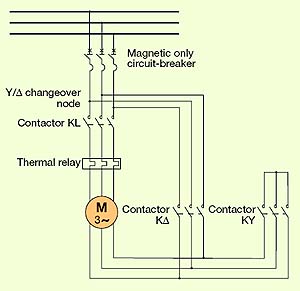
Magnetic only circuit-breaker - Автоматический выключатель с электромагнитным расцепителем
Y/Δ changeover node - Узел переключения со звезды на треугольник
Contactor KL - Контактор KL
Thermal relay - Тепловое реле
Contactor KΔ - Контактор KΔ
Contactor KY- Контактор KY
Параллельные тексты EN-RU Star-delta Y/Δ starting
Star-delta starting is the best known system and perhaps the commonest starting system at reduced voltage; it is used to start the motor reducing the mechanical stresses and limiting the current values during starting; on the other hand, it makes available a reduced inrush torque.This system can be used for motors with terminal box with 6 terminals and double supply voltage.
It is particularly suitable for no-load starting or with low and constant load torque or lightly increasing load torque, such as in the case of fans or low power centrifugal pumps.
Making reference to the diagram of Figure 6, the starting modality foresees the initial phase with star-connection of the windings to be realized through the closing of the circuit-breaker, of the line contactor KL and of the star contactor KY.
After a suitable predetermined period of time, the opening of the contactor KY and the closing of KΔ allow switching to delta-connection, which is also the configuration of normal running position.
[ABB]Пуск переключением со звезды на треугольник
Пуск переключением со звезды на треугольник является самым известным способом и, возможно, самой распространенной схемой пуска на пониженном напряжении. С одной стороны, этот способ используется для снижения механических нагрузок и ограничения пускового тока, а с другой - обеспечивает уменьшение пускового момента.Такая возможность может быть реализована в двигателях с шестью зажимами в выводной коробке, что позволяет питать его от двух напряжений.
Особенно этот способ подходит для ненагруженного пуска и пуска с низким постоянным или немного увеличивающимся вращающим моментом, например, для пуска вентиляторов или маломощных центробежных насосов.
Схема пуска переключением со звезды на треугольник представлена на рисунке 6. В начальный момент пуска обмотки статора соединяют звездой путем замыкания контактов автоматического выключателя, линейного контактора KL и контактора KY со схемой "звезда".
По истечении заданного времени контакты контактора KY размыкаются и замыкаются контакты контактора КΔ со схемой треугольник.
В результате выполняется переключение обмоток статора со схемы «звезда» на схему «треугольник».
Обе схемы соединения обмоток являются схемами нормального рабочего режима.
[Перевод Интент]Тематики
Обобщающие термины
EN
- star-delta starting
- Y/Δ starting
DE
FR
Англо-русский словарь нормативно-технической терминологии > star-delta starting
-
12 Y/Δ starting
пуск переключением со звезды на треугольник
-EN
star-delta starting
the process of starting a three-phase motor by connecting it to the supply with the primary winding initially connected in star, then reconnected in delta for the running condition
[IEV number 411-52-16]FR
démarrage étoile-triangle
mode de démarrage d'un moteur triphasé à tension réduite, consistant à relier à la source à tension constante les enroulements statoriques, d'abord en couplage étoile, puis à passer au couplage triangle pour le fonctionnement normal
[IEV number 411-52-16]Magnetic only circuit-breaker - Автоматический выключатель с электромагнитным расцепителем
Y/Δ changeover node - Узел переключения со звезды на треугольник
Contactor KL - Контактор KL
Thermal relay - Тепловое реле
Contactor KΔ - Контактор KΔ
Contactor KY- Контактор KY
Параллельные тексты EN-RU Star-delta Y/Δ starting
Star-delta starting is the best known system and perhaps the commonest starting system at reduced voltage; it is used to start the motor reducing the mechanical stresses and limiting the current values during starting; on the other hand, it makes available a reduced inrush torque.This system can be used for motors with terminal box with 6 terminals and double supply voltage.
It is particularly suitable for no-load starting or with low and constant load torque or lightly increasing load torque, such as in the case of fans or low power centrifugal pumps.
Making reference to the diagram of Figure 6, the starting modality foresees the initial phase with star-connection of the windings to be realized through the closing of the circuit-breaker, of the line contactor KL and of the star contactor KY.
After a suitable predetermined period of time, the opening of the contactor KY and the closing of KΔ allow switching to delta-connection, which is also the configuration of normal running position.
[ABB]Пуск переключением со звезды на треугольник
Пуск переключением со звезды на треугольник является самым известным способом и, возможно, самой распространенной схемой пуска на пониженном напряжении. С одной стороны, этот способ используется для снижения механических нагрузок и ограничения пускового тока, а с другой - обеспечивает уменьшение пускового момента.Такая возможность может быть реализована в двигателях с шестью зажимами в выводной коробке, что позволяет питать его от двух напряжений.
Особенно этот способ подходит для ненагруженного пуска и пуска с низким постоянным или немного увеличивающимся вращающим моментом, например, для пуска вентиляторов или маломощных центробежных насосов.
Схема пуска переключением со звезды на треугольник представлена на рисунке 6. В начальный момент пуска обмотки статора соединяют звездой путем замыкания контактов автоматического выключателя, линейного контактора KL и контактора KY со схемой "звезда".
По истечении заданного времени контакты контактора KY размыкаются и замыкаются контакты контактора КΔ со схемой треугольник.
В результате выполняется переключение обмоток статора со схемы «звезда» на схему «треугольник».
Обе схемы соединения обмоток являются схемами нормального рабочего режима.
[Перевод Интент]Тематики
Обобщающие термины
EN
- star-delta starting
- Y/Δ starting
DE
FR
Англо-русский словарь нормативно-технической терминологии > Y/Δ starting
См. также в других словарях:
Cylinder stresses — Circumferential stress is a type of mechanical stress of a cylindrically shaped part as a result of internal or external pressure. The classic example of circumferential stress is the tension applied to the iron bands, or hoops, of a wooden… … Wikipedia
Reynolds stresses — In fluid dynamics, the Reynolds stresses (or, the Reynolds stress tensor) is the stress tensor in a fluid due to the random turbulent fluctuations in fluid momentum. The stress is obtained from an average (typically in some loosely defined… … Wikipedia
Ceramic engineering — Simulation of the outside of the Space Shuttle as it heats up to over 1,500 °C (2,730 °F) during re entry into the Earth s atmosphere Ceramic engineering is the science and technology of creating objects from inorganic, non metallic… … Wikipedia
Nanoparticle — In nanotechnology, a particle is defined as a small object that behaves as a whole unit in terms of its transport and properties. Particles are further classified according to size[1] : in terms of diameter, coarse particles cover a range… … Wikipedia
Nanomaterials — Part of a series of articles on Nanomaterials Fullerenes … Wikipedia
fundamentalism — fundamentalist, n., adj. /fun deuh men tl iz euhm/, n. 1. (sometimes cap.) a movement in American Protestantism that arose in the early part of the 20th century in reaction to modernism and that stresses the infallibility of the Bible not only in … Universalium
Abiotic stress — is defined as the negative impact of non living factors on the living organisms in a specific environment. [cite web|url=http://www.biology online.org/dictionary/Abiotic stress|title=Abiotic Stress|publisher=Biology Online|accessdate=2008 05 04]… … Wikipedia
Hoop stress — is mechanical stress defined for rotationally symmetric objects being the result of forces acting circumferentially (perpendicular both to the axis and to the radius of the object). Along with axial stress and radial stress, it is a component of… … Wikipedia
Roman concrete — The Pantheon in Rome, Italy, is an example of Roman concrete construction. Roman concrete (also called Opus caementicium) was a material used in construction during the late Roman Republic through the whole history of the Roman Empire. Roman… … Wikipedia
TMT steel — Thermo mechanically treated steel known as TMT steel can be described as a new generation high strength steel having superior properties such as weldability, strength, ductility and bendability meeting highest quality standards at international… … Wikipedia
Leibniz: truth, knowledge and metaphysics — Nicholas Jolley Leibniz is in important respects the exception among the great philosophers of the seventeenth century. The major thinkers of the period characteristically proclaim the need to reject the philosophical tradition; in their… … History of philosophy
